


To tailor a resume to a job description without rewriting it by hand, run your existing resume and the job posting through a tool that cuts your resume down to fit the role, shows you exactly what it removed and why, and lets you approve every change before you send it. I built Resume Prune to do that, because I wanted the same rules applied the same way on every application, with nothing invented and nothing hidden.
Quick disclosure before we go further: Resume Prune is mine. I built it and I run it, and there is a paid version. This is still me showing you the tool I actually use when I apply for things, not a pitch.
What follows is why it exists, and the parts I would flag before you try it.
I was already tailoring my resume with AI. It kept going sideways.
Before Resume Prune, I tailored my own resume with a plain custom GPT. Paste the resume, paste the job description, ask it to match the two. It worked well enough to keep doing it, and badly enough to bug me every single time.
I love building things. So instead of fighting the same four problems on every application, I built a tool that fixes them the same way every time.
Problem 1: Same input, different resume every run
I would give the GPT the same resume and the same job posting twice and get two different resumes. Different bullets kept, different order, different length. There was no consistency, so I could never trust that it was making the choice I wanted. It was making a choice.
Resume Prune applies fixed rules. Same resume, same job, same result. It cuts to the role instead of reimagining your history on a whim.
Problem 2: It padded and invented to hit keywords
To match the job description, the GPT would inflate on its own. A responsibility I touched once became a core skill. A tool I opened twice became something I was fluent in. It was trying to be helpful, and it was writing checks I could not cash in an interview.
Resume Prune only cuts. It trims your real resume down to what fits the job. It does not add experience you do not have, because the fastest way to lose an interview is to get asked about a line you cannot back up.
Problem 3: I could not see what changed
The GPT handed me a finished resume with no idea what it dropped. I would scan it, get nervous, and paste both versions side by side to diff them myself. That defeated the point.
This is the part I care about most, so it became the feature I lead with. Resume Prune shows you the cuts. It lists what it removed, and why, next to your tailored resume. You are not trusting a black box. You are reviewing a decision.
Problem 4: Bloated bullets and no length discipline
Left alone, the GPT wrote five-line bullets and cover letters that ran forever. I would not read that either.
Resume Prune enforces caps. Bullet lengths stay tight, cover letters stay to three short paragraphs, and word counts stay in range. It reads like a resume a busy hiring manager can actually skim.
The feature I show people first: it shows you the cuts
If you try one thing, try this. Paste a resume and a job posting, and Resume Prune returns your tailored resume with a running list of what it cut and the reason for each cut. Too senior for this role. Not relevant to this job. Duplicated a stronger bullet above.
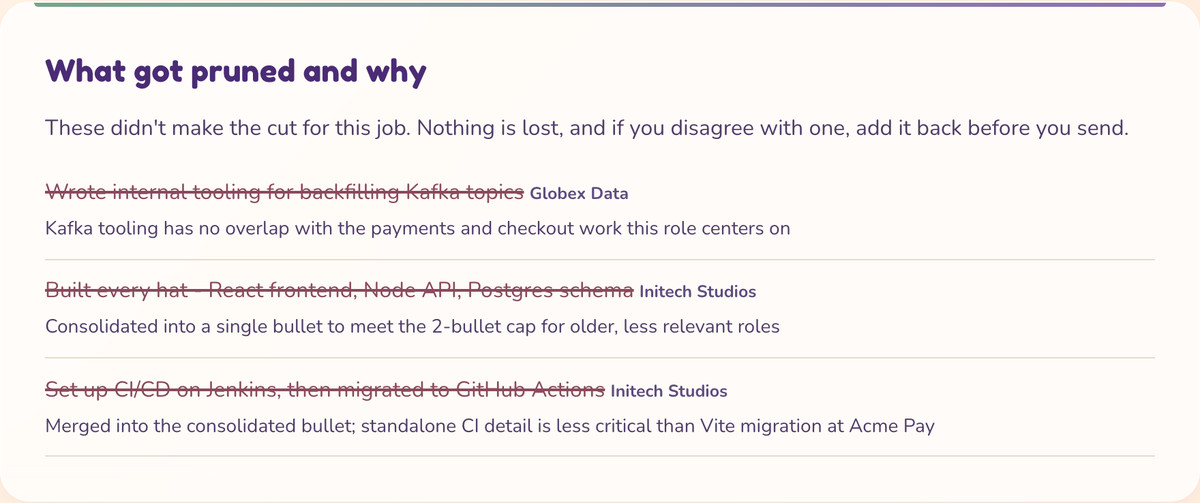
You read the reasons, you keep or restore anything you disagree with, and then you send it. The AI does the tedious part. You keep the final say.
The rest of what it does
The cutting is the core. These are the parts I added because I wanted them for my own hunt.
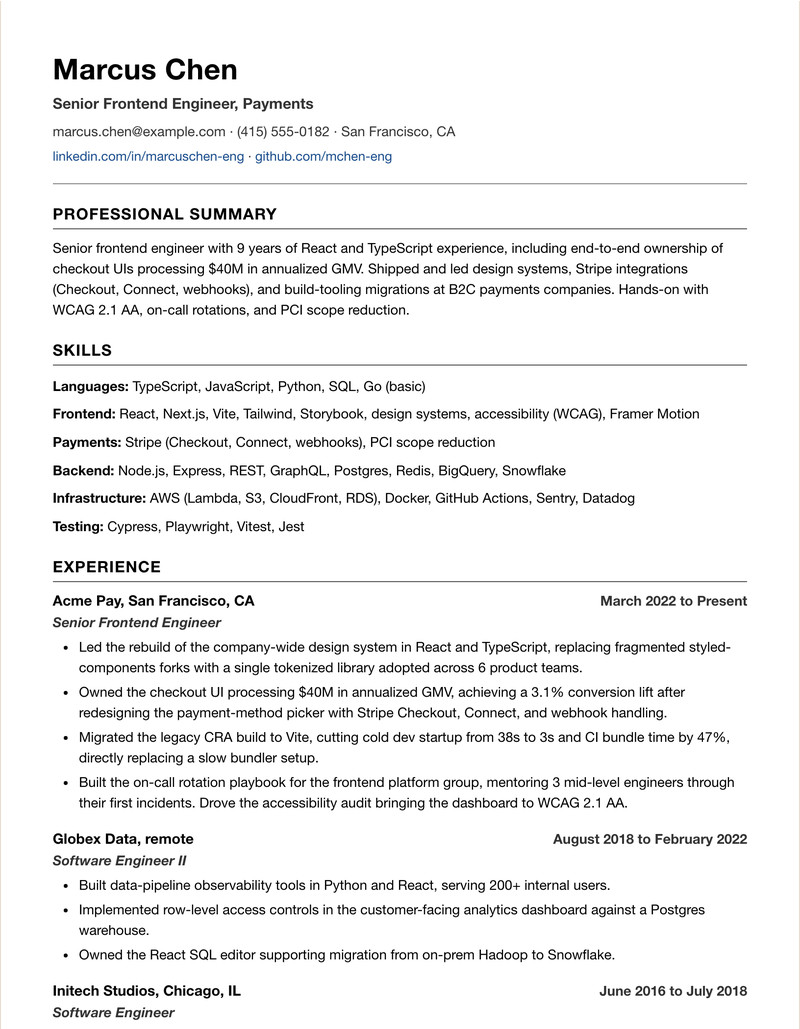
A match score. Every tailored version gets a 1 to 10 score against the job description, so I can see at a glance whether a role is a real fit or a reach before I spend time on it.
Gap fill. When the score flags something the job wants that my resume does not show, I can describe real experience I actually have in plain words, and it works that into a proper bullet. It fills the gap with your truth, not a fabrication.
A hosted resume link. Instead of emailing a PDF, I can publish a tailored version to a clean web page with its own link. It looks like a real page, not an attachment someone has to download.
A hunt tracker. The part that keeps me sane. Every application moves through applied, interviewing, and offer, so I am not digging through my inbox trying to remember who I heard back from.
Cover letters. It drafts a three-paragraph cover letter from the same tailored resume and job posting, in the same tight format.
The one thing I always tell people
Always read it before you send it. It is AI. On a good day it cuts cleanly and the reasons make sense. On an off day it can reframe a bullet a little generously, and you are the one who has to defend that line in the room. Resume Prune is built to make you the final check, not to replace it. Read the cuts, fix anything that reads off, then send.
Who this is for
This is for anyone applying to a lot of jobs who knows they should tailor each resume and cannot face doing it by hand every time. If you have ever sent the same generic resume to fifteen postings because customizing all fifteen felt impossible, this closes that gap. Tailor each one in a couple of minutes, see what changed, keep control.
Plans
| Plan | What you get |
|---|---|
| Free | 2 tweaks a month, no signup and no card. Enough to run your real resume through it and see the cuts. |
| Sprint, $9/week | 20 tweaks a week. For an active stretch of applying, and you can pause it the week you stop. |
| Pro, $14/month | 40 tweaks a month. Same features as Sprint, steadier pace, billed monthly instead of weekly. |
Try it on your own resume
The best way to judge it is to feed it your real resume and a job you actually want, and read what it cuts. Start with the free sample. Two tweaks, no card needed to look.
If you want more of my origin-story builds, here is another tool I built to fix a problem I kept hitting, and the rest live in Digital Products.
FAQ
How do you tailor a resume to a job description?
Match your existing resume to the specific posting by cutting anything the role does not need and keeping the experience that maps to it, rather than rewriting from scratch. A tool like Resume Prune does the cutting for you and shows you what it removed so you can approve it.
Does Resume Prune make up experience I do not have?
No. It only cuts your real resume down to fit the job. If there is a genuine gap, the gap-fill step asks you to describe real experience in your own words and turns that into a bullet. It does not invent history.
Is there a free version of Resume Prune?
Yes. The free tier is 2 tweaks a month with no signup and no card, which is enough to run your own resume and see the cuts before you pay for anything.
What is the difference between Sprint and Pro?
The features are the same. What changes is how many tweaks you get and how often you are billed. Sprint is $9 a week for 20 tweaks a week, built for a short heavy stretch of applying, and you can pause it. Pro is $14 a month for 40 tweaks a month, for a steadier ongoing hunt.
Can I share my resume as a link instead of a PDF?
Yes, on any paid plan. You can publish a tailored version to a clean hosted web page with its own link, so you send a page instead of an attachment.
A tool I built
Resume Prune
You don’t need a new resume, you need to prune the one you have. Paste a job description and get back a matching resume and cover letter.
Prune your resume →I run an affiliate program on the tools I build. Approved affiliates earn 20% on what their referrals pay, for up to a year. US only for now. See the program →